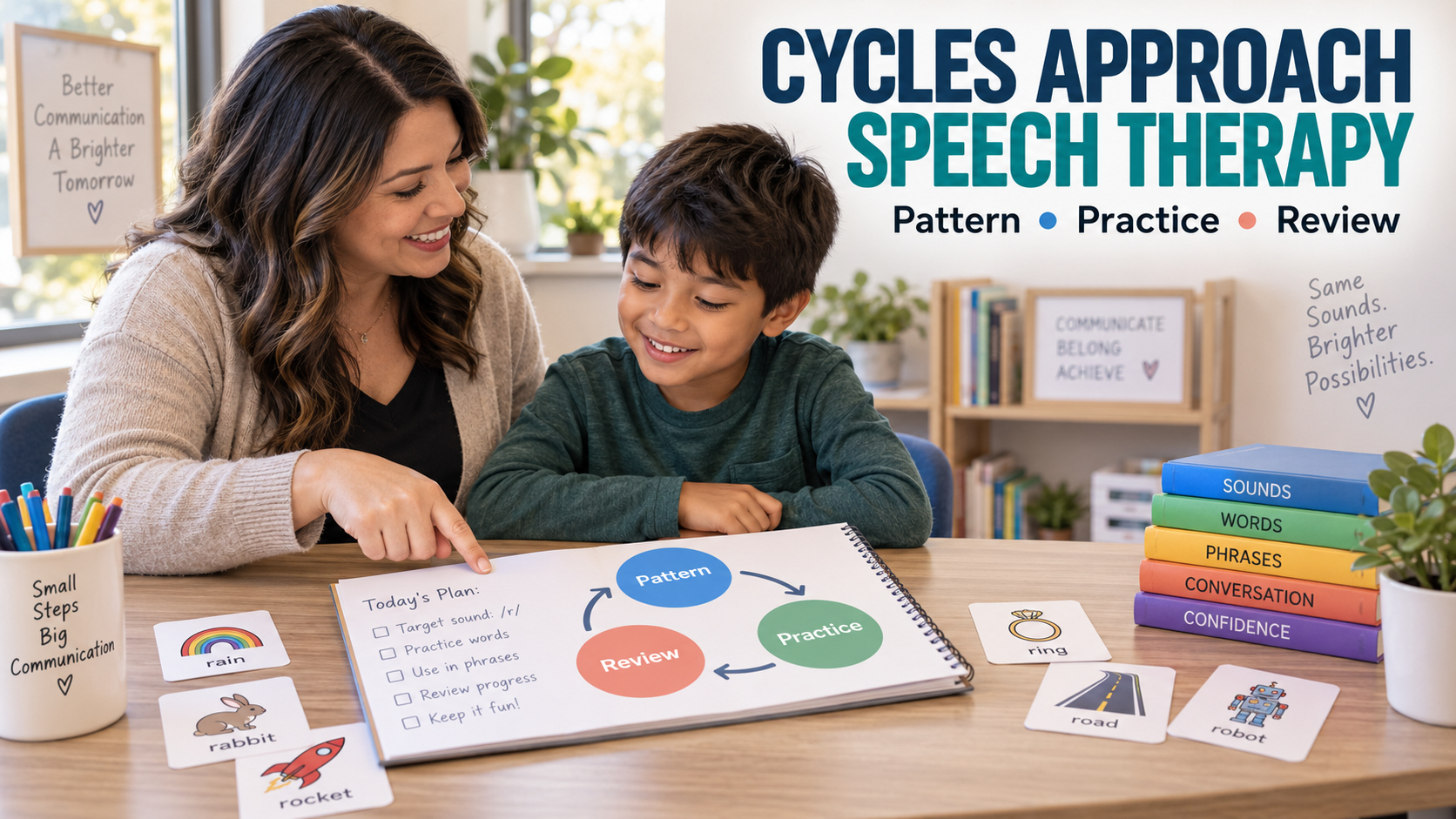
The cycles approach in speech therapy is a pattern-based way to organize phonological intervention over time. Instead of waiting for one sound pattern to become fully established before considering another, the clinician selects priority patterns, practices them in focused periods, and revisits them as part of a planned cycle. The exact targets and supports still depend on the learner’s speech profile, age, intelligibility, participation needs, and clinical judgment.
This guide explains the planning logic, how to choose targets, what a practice period can include, and how to review progress without treating the approach as a rigid script. It is an educational overview rather than individualized treatment advice. For broader professional context, review the ASHA Practice Portal topic on speech sound disorders.
Table of Contents
- What the cycles approach is designed to organize
- Start with a pattern and participation analysis
- Plan a cycle with focused practice
- Use cues and communication opportunities thoughtfully
- Review progress and choose the next cycle
- Common boundaries and frequently asked questions
What the Cycles Approach Is Designed to Organize
The cycles approach organizes intervention around phonological patterns that affect how a learner’s speech system is working. A cycle may include a small set of targets for a defined period, with repeated practice and later review. The learner does not have to produce every target accurately before the clinician moves to the next planned pattern.
The approach is different from choosing isolated sounds only because they are difficult. The clinician considers patterns, stimulability, intelligibility, error consistency, functional words, and the learner’s access to practice. The goal is not a fixed order that applies to every learner. The plan should be responsive to the speech sample, communication priorities, and response to intervention.
A cycle plan can help a team answer:
- Which pattern is affecting intelligibility or participation?
- Which target words make the practice meaningful?
- What cue or model gives the learner access to the contrast?
- How will the team know whether the pattern is changing?
- When will the clinician revisit the target or adjust the plan?
The ASHA practice information can help clinicians connect assessment, intervention, and functional outcomes. Use current professional guidance and individualized assessment rather than relying on a short description of any one approach.
Start With a Pattern and Participation Analysis
Begin with a speech sample and a clear reason for intervention. Consider the patterns that occur, the contexts in which they occur, the words the learner wants or needs to say, and how unfamiliar listeners understand the message. Include the learner’s communication modes, language background, hearing status, motor and sensory access, and relevant partner information.
Avoid treating a single production as the whole pattern. Look across words, positions, activities, and speaking partners when possible. A pattern may be more noticeable in connected speech than in a word list, or it may appear differently in a familiar routine than in a structured task.
Choose target words that have a communication purpose. A target can be practiced in a picture, game, book, routine, or personal message, but the learner should have a reason to communicate rather than repeat an unrelated list. The team can still use a structured set when it answers a specific clinical question.
Before the cycle starts, record:
- the pattern or contrast being addressed;
- the target contexts and functional words;
- the learner’s current response and stimulability;
- the cue, model, and response mode available;
- the communication partner and practice routine; and
- the observation that will guide the next decision.
This preparation makes the cycle measurable without turning it into a promise that a target will be mastered within one period.
Plan a Cycle With Focused Practice
A cycle can be organized into short, repeatable sessions. The exact length and number of sessions should fit the learner and clinical plan. The structure below is a planning aid, not a universal protocol.
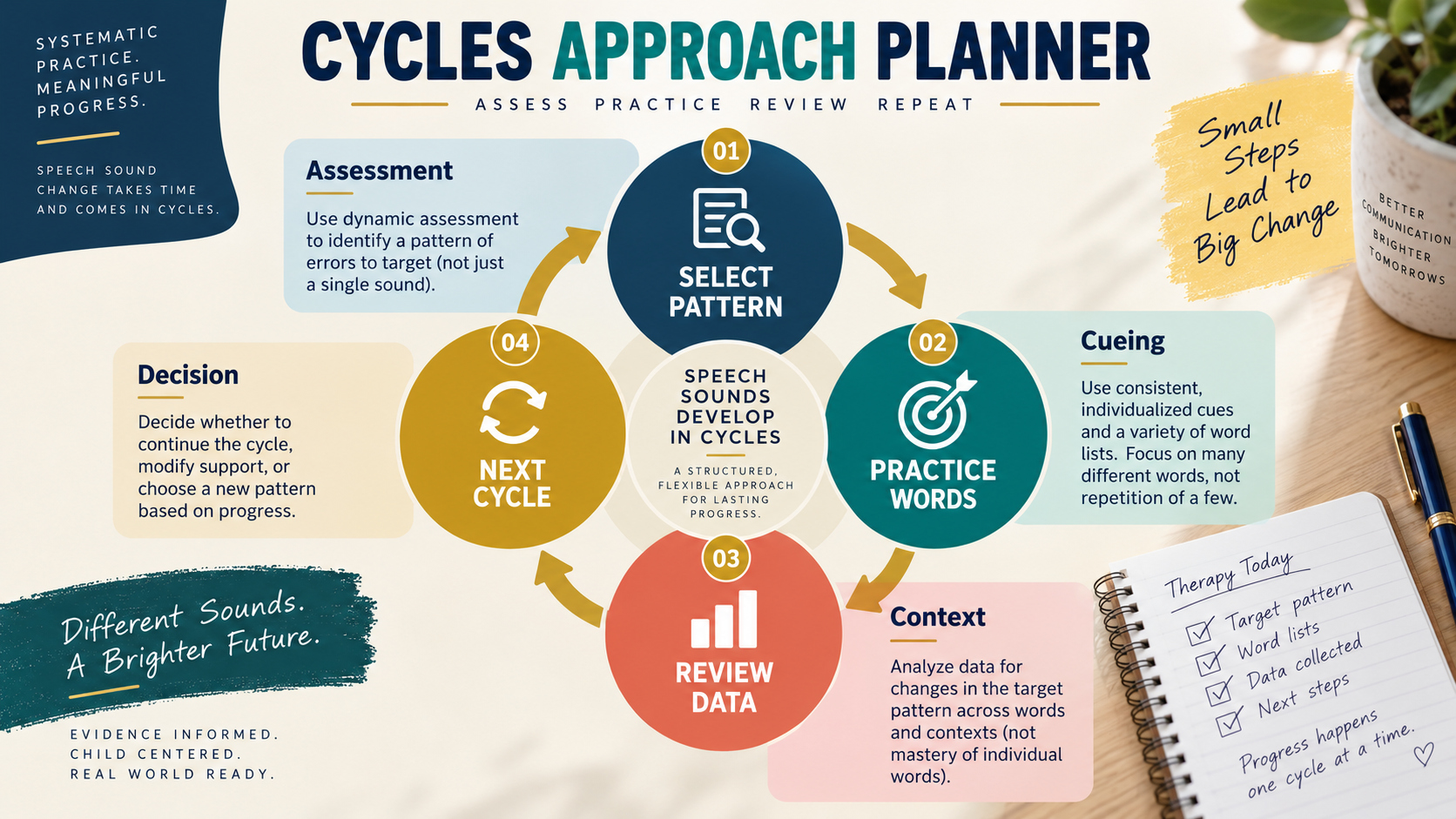
Orient: Briefly connect the target pattern to the learner’s words and communication purpose. Use a mirror, visual, gesture, written cue, or model when that support improves access.
Practice: Provide multiple opportunities in a meaningful activity. Use target words, phrases, and connected messages as appropriate. Keep the partner responsive and allow the learner to communicate through the available mode.
Support: Choose cues that make the contrast or pattern easier to perceive and produce. Record the cue rather than assuming that every prompt has the same effect. A clinician may use a model, visual, tactile or gestural cue, slowed rate, contrast, or another individualized support.
Connect: Move the target into a phrase, story, game, classroom-related message, or personal routine when that is appropriate. The connection helps the team see whether practice is beginning to affect functional speech.
Review: Note the response, support, context, and next decision. A target can be revisited later even when the learner did not reach a predetermined accuracy threshold. The cycle is a way to distribute attention and review patterns, not a reason to ignore new clinical information.
Keep the number of targets manageable. Too many targets can reduce meaningful practice and make it difficult to identify which support helped. A short list with repeated opportunities may produce more useful information than a long list touched only once.
Use Cues and Communication Opportunities Thoughtfully
Prompting should support access while preserving the learner’s role in the message. Start with the least intrusive cue likely to help, then increase support when needed. Record what changed: the model, visual, rate, word context, partner response, or amount of wait time.
A practice opportunity can include:
- hearing a contrast or model;
- choosing a target word that matters in the activity;
- producing a sound or word in a supported context;
- using the target in a phrase or connected message; and
- communicating to a partner who responds to the content.
Do not let a high trial count replace communication. A learner may produce a target in a structured practice but be harder to understand when telling a partner what happened. Conversely, a meaningful message may include an approximation that gives the team useful information about access and intelligibility.
Use age-respectful materials and topics. A younger learner may practice through play or a shared book, while an older learner may use a personal experience, classroom task, work routine, or community message. The speech target can remain specific while the communication context changes.
If the learner uses AAC, sign, gesture, writing, or another mode alongside speech, keep that access available. Speech sound intervention should not remove a reliable way for the learner to communicate a message, refuse, request help, or participate while speech is being practiced.
Review Progress and Choose the Next Cycle
Progress review should describe what changed under the recorded conditions. Consider accuracy, consistency, stimulability, cue level, intelligibility, word context, connected speech, partner understanding, and participation. No single number describes the whole response.
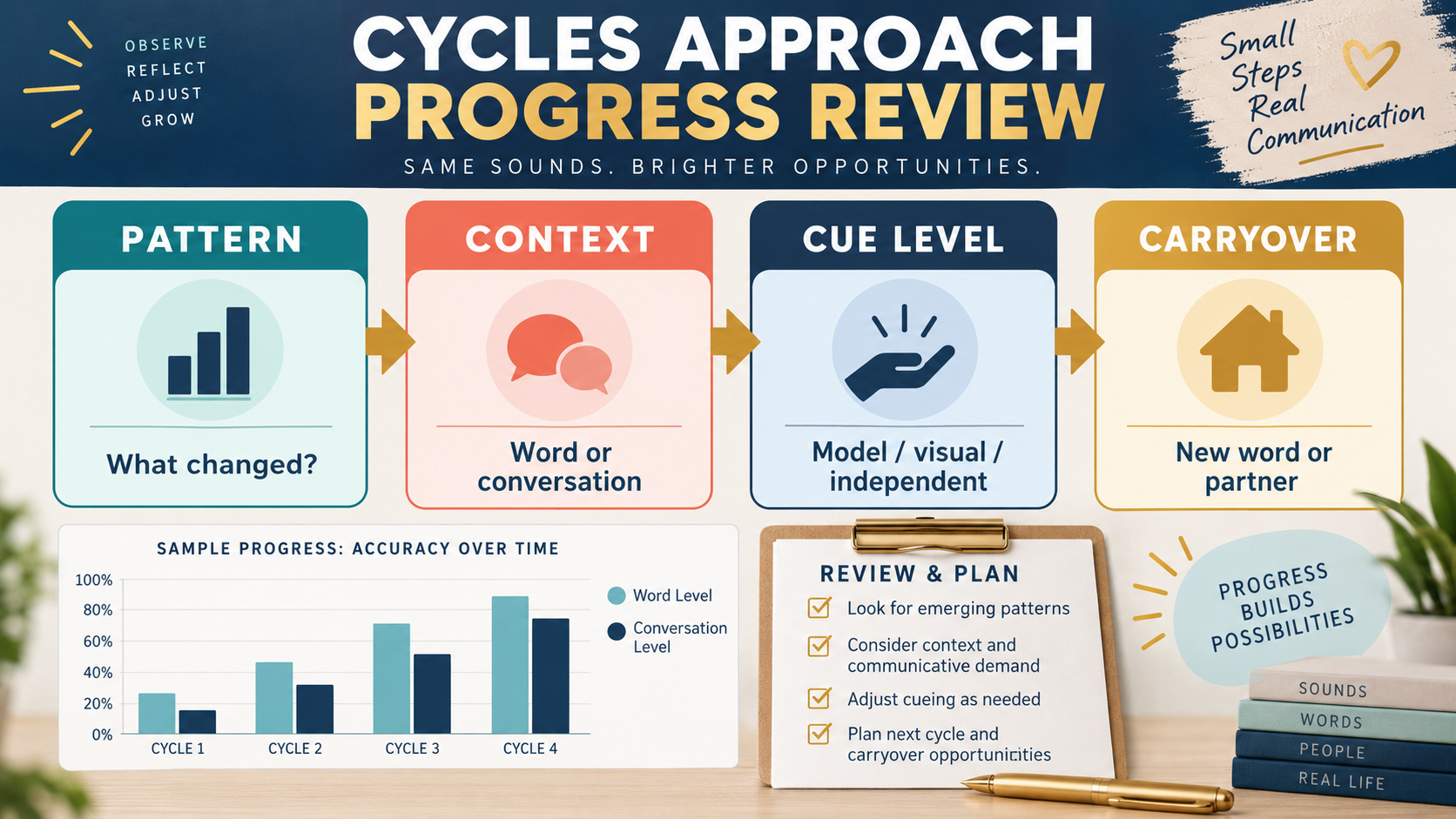
Possible review fields include:
- target pattern and word or phrase context;
- independent response and cue level;
- response in structured and connected activities;
- listener understanding or repair;
- functional words and communication purpose;
- partner, setting, and language context; and
- whether to repeat, change, generalize, or pause the target.
Look for a pattern across sessions rather than reacting to one unusually strong or difficult day. If the learner responds with less support in meaningful words, preserve those opportunities. If the pattern changes in a new setting, examine the partner, rate, vocabulary, and access before interpreting the result.
At the end of a review period, the team may continue a target, revisit it later, change the context, select another pattern, or collect more information. The decision should be connected to the learner’s communication needs and the evidence recorded during the cycle.
Common Boundaries and Practical Cautions
The cycles approach does not remove the need for assessment. It does not determine the correct target order for every learner, guarantee a specific outcome, or replace consideration of hearing, motor speech, language, multilingual development, structural factors, or functional participation.
It also should not be reduced to a worksheet or a fixed number of repetitions. The approach is a way of organizing pattern-based intervention and review. The clinician still needs to decide how to cue, what words matter, how to support access, and when the plan should change.
Document what the learner did and under what conditions. A short note that identifies the target, cue, context, partner response, and next action can be more informative than a score with no opportunity definition. Use the record to coordinate with families, educators, and other team members when appropriate.
Frequently Asked Questions
What is the cycles approach in speech therapy?
It is a pattern-based way to organize phonological intervention over planned periods. The clinician selects priority patterns, practices them with meaningful targets, reviews the response, and revisits or adjusts the plan over time.
Does a learner need to master one pattern before moving to another?
Not necessarily. The cycles approach distributes attention across selected patterns and returns to them for review. Target decisions should be individualized and based on the speech profile, participation needs, response to intervention, and current professional guidance.
What should be recorded during cycles approach sessions?
Record the pattern, target context, response, cue level, communication purpose, partner, setting, listener understanding, and next decision. Define the opportunity so data can be interpreted across sessions.
Can cycles practice include connected speech?
Yes, when the learner has an accessible route into the target. Structured practice can be connected to phrases, stories, play, classroom tasks, personal messages, or other meaningful contexts as appropriate.
The cycles approach in speech therapy is best treated as a flexible planning and review framework. Start with an individualized pattern and participation analysis, use meaningful targets with thoughtful cues, record the conditions around the response, and let the next cycle follow the evidence.