Before you register, map the praxis speech language pathology exam requirements that apply to your actual goal. “Requirements” can mean several different things: which test a state or agency accepts, when a graduate student should take it, what ETS needs for registration and admission, what documents support an accommodation, how scores reach a credentialing body, or what a particular state requires for licensure. These are related questions, but they do not have one universal answer.
Table of Contents
- Separate the Four Meanings of “Requirements”
- Check the State or Agency Rule First
- Understand the ASHA Certification Context
- Review ETS Registration and Admission Requirements
- Plan for Score Use, Not Just Test Day
- Avoid Common Requirement Mistakes
- A Requirements Summary You Can Recheck
The safest approach is to separate the sources. ETS controls the test registration process and live appointment information. ASHA explains how the national examination fits into its certification standards. A state board, school agency, graduate program, or other responsible authority may add rules for the credential you are pursuing. A study guide can organize the questions, but it should not replace any of those authorities.
Separate the Four Meanings of “Requirements”
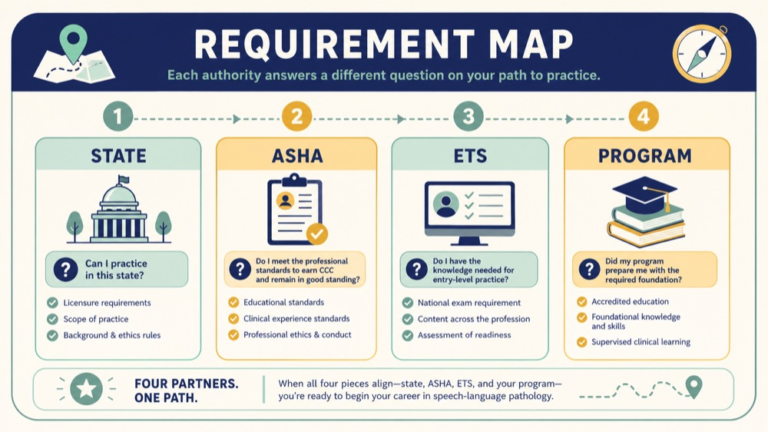
Start by naming the requirement you are trying to verify. This prevents a common mistake: reading an exam description and assuming it answers a licensure or certification question. The current ETS 5331 page describes the test’s scope, format, delivery, and administrative information. ASHA’s guidance places the exam within a broader certification pathway. Your state or agency decides what it will accept for its own credential.
- Test selection: Which Praxis assessment or code does the responsible authority identify?
- Readiness or timing: When should you register based on graduate coursework, clinical practicum, or an agency deadline?
- Registration and admission: What account, appointment, payment, identification, and check-in steps apply?
- Credential use: Where must the score be sent, what passing score applies, and how long is the result accepted?
Write your goal in one sentence before opening multiple tabs. For example: “I am preparing to meet my state school-credential requirement after completing my graduate program,” or “I am checking the exam step in an ASHA certification application.” That sentence determines which authority deserves the final say.
Check the State or Agency Rule First
State and agency requirements can differ. ASHA explains that the Praxis exam is used for ASHA certification and by state boards or agencies, but it also notes that each state determines the passing score it uses for professional licensure or teacher credentialing. A score that is acceptable for one purpose is not automatically the complete answer for another. Before paying for an appointment, locate the current page or office for the state or agency that will review your credential.
Look for the exact test name or code, the required score, the timing of the exam in the application process, score-reporting instructions, and any rule about how recent the result must be. Also check whether the agency wants the score sent directly from ETS, whether an institution code is required, and whether other coursework, supervised experience, or documentation is part of the same application. Do not infer a complete credential checklist from the Praxis page alone.
If your graduate program has a testing recommendation, compare it with the state or agency rule. Programs often help students plan the transition from coursework and practicum into clinical practice, while the credentialing authority determines what it will accept. When the sources appear inconsistent, ask the responsible office a specific question and keep the answer with the date and link you checked.
Your state or agency research note should capture:
- The name of the credential or license you are pursuing.
- The responsible board, department, school agency, or certification organization.
- The accepted test name and code.
- The passing score and scale, if the current rule publishes one.
- When the exam must be completed in relation to the application.
- Where scores must be sent and whether direct reporting is required.
- How long a score remains acceptable for that credential.
- Other non-exam requirements that must be completed separately.
Understand the ASHA Certification Context
ASHA describes the Speech-Language Pathology Praxis Examination (5331) as an integral component of its certification standards. The examination is administered by ETS, while ASHA’s Council for Clinical Certification in Audiology and Speech-Language Pathology is involved in certification standard setting and the final determination of the passing score for ASHA certification. That division of responsibility matters: ETS is the source for the appointment and testing process, while ASHA is the source for its certification pathway.
ASHA’s current guidance also connects eligibility to the broader certification process, including completion of graduate-level academic coursework and clinical practicum and program judgment about required knowledge and skills. It recommends that individuals consider registration and testing after completing those milestones or during an appropriate early-practice period, while also considering state licensing requirements. The practical lesson is to plan the exam in relation to your program and credential timeline rather than treating registration as an isolated purchase.
ASHA also explains that state passing scores can be higher or lower than the score used for ASHA certification. It notes that exam results submitted for initial certification must come directly to ASHA from ETS and that score-age rules apply. Because certification rules can be revised, use the linked ASHA page and current application instructions for the decision you need to make today.
Review ETS Registration and Admission Requirements

ETS’s registration flow begins with an account. The process then asks you to find the appropriate test, review availability, choose a test date and location or another available delivery option, review your cart and personal information, and enter payment information. The exact appointment information appears in the account and may change with availability. Save the confirmation after completion and read the appointment instructions again before test day.
Admission is a separate checkpoint from eligibility. A learner can be academically ready and still arrive without the identification or documentation required by the provider. The ETS Study Companion explains that computer test takers can expect to provide proper identification at a test center and can learn the interface before the testing time begins. Follow the current admission instructions for your specific appointment, including rules for personal items, security, and approved accommodations.
For accommodations, start early. ETS provides an accommodations process, and the registration page links to a request form. The documentation and review timeline may affect when you can schedule. Do not assume that a request is approved merely because it was submitted, and do not assume an approval applies to every delivery method or appointment. Keep the approval notice and appointment details together, and contact the responsible provider when the language is unclear.
- Use the current ETS 5331 listing to confirm the test identity and format.
- Create or access the Praxis account used for registration.
- Review state or agency requirements before adding the test to the cart.
- Check availability and choose a date that fits the credential timeline.
- Review the delivery method and location shown in the account.
- Confirm personal information before payment.
- Read the current identification and check-in instructions.
- Complete accommodation steps through the responsible ETS process when needed.
- Save confirmation, score-recipient, and appointment information.
- Use official appointment-management instructions for changes.
Plan for Score Use, Not Just Test Day
Requirements continue after the appointment. Decide which organization needs the result and whether the score must be sent directly from ETS. Check the receiving organization’s code and instructions against its current page. If you are applying for ASHA certification, review ASHA’s score-acceptability language and application window. If you are applying for a state credential, use that state’s rule instead of copying the ASHA rule.
Keep a small requirements file with the source page, the date checked, the exact wording that matters, and the action you still need to take. This is especially useful when your program, state, and certification organization use different terms for the same milestone. A screenshot can preserve context, but the link and date tell you when the information needs to be rechecked.
A useful file may contain:
- Current ETS 5331 page and Study Companion.
- Current ETS registration or appointment instructions.
- Your state or agency testing and credential page.
- ASHA certification guidance, if ASHA certification is your goal.
- Program contact or graduate-office instructions.
- Appointment confirmation and score-recipient details.
- Accommodation approval or documentation instructions, if applicable.
- A dated list of questions sent to an authority and the replies received.
Avoid Common Requirement Mistakes
The most expensive mistakes are often category mistakes. A learner sees “computer delivered” and assumes a particular room setup; sees a passing score and assumes it applies to every state; sees a graduate-program recommendation and assumes it is a legal deadline; or sees an old fee and treats it as a current total. The fix is simple but disciplined: label every fact with the authority that owns it and the date on which you checked it.
Another mistake is studying toward a broad identity rather than the current blueprint. ETS states that the 5331 test measures knowledge and its application across foundational knowledge, professional practice, and specialized areas. Use the current Study Companion and test page to understand the assessed scope, then use your coursework and practice to build the reasoning behind it. Do not seek purported official, recalled, or leaked test content; it is not a sound or authorized study boundary.
- Do not use a competitor’s registration instructions as the final authority.
- Do not assume ASHA and a state board use identical score rules.
- Do not book before checking the credential timeline that matters to you.
- Do not treat an accommodation request as an approval.
- Do not carry an old date, fee, or center list into a new appointment.
- Do not postpone score-recipient research until after the application deadline.
- Do not confuse test readiness with completion of every credential requirement.
- Do not replace source verification with a confident-sounding summary.
A Requirements Summary You Can Recheck
Use this sequence: identify the credential goal, check the responsible state or agency, confirm the accepted Praxis test, review ASHA guidance if certification is part of the plan, read the current ETS 5331 listing, complete registration and accommodation steps, prepare for admission, and document how the result will be used. Each step has a different owner. That is why a source map is more reliable than one universal checklist.
For current details, read the ETS Speech-Language Pathology 5331 page, the ETS registration process, the ETS Study Companion, and the ASHA Praxis exam guidance. If you want a structured study path alongside your requirements file, review the SLP Study Center preparation resources and keep the official rule checks separate from your learning plan.