
Use an slp praxis exam day checklist to turn a high-stakes morning into a sequence of small, verifiable decisions. The goal is not to create a superstition-heavy routine or promise a particular result. It is to make sure your appointment, documents, travel plan, equipment, energy, and pacing choices are aligned before the clock starts. ETS describes the Speech-Language Pathology Praxis 5331 as a computer-delivered selected-response test, and its live listing provides the current administrative details. Treat that listing and your ETS account as the source of truth for the appointment you actually booked.
Table of Contents
- What an Exam Day Checklist Can and Cannot Do
- Confirm Your Registration Details
- Pack for the Appointment Without Overpacking
- Plan Arrival and the Check-In Sequence
- Use a Simple Pacing Plan
- Finish the Night Before and Morning Of
- A Printable Final Check
A good checklist has two layers. The first layer confirms items controlled by ETS or the testing location: the selected test, appointment date and time, delivery method, location, identification requirements, and any approved accommodations. The second layer covers choices you control: what to pack, when to leave, how to handle uncertainty, and how to use the test interface. Keeping those layers separate helps you avoid spending the night before trying to memorize a rule that should have been checked in your account.
What an Exam Day Checklist Can and Cannot Do
An exam day checklist is a risk-control tool. It can reduce preventable friction, but it cannot change a registration record, guarantee a score, or replace a current policy. If a detail affects admission, payment, rescheduling, identification, or accommodations, verify it with ETS or the responsible testing provider. The checklist is strongest when it points you to the right place to confirm a fact.
It also helps you reserve mental energy for the exam itself. Graduate-level SLP preparation involves a wide range of knowledge, including assessment, intervention, professional practice, language, speech, hearing, cognition, and feeding and swallowing. On test day, your job is to apply what you know to the item in front of you. A prepared route and a simple pacing rule keep logistical questions from competing with that work.
- Use the live ETS test page for the current 5331 format and administrative details.
- Use your ETS account for the appointment record, location, date, time, and delivery choice.
- Use the testing provider’s instructions for identification, check-in, prohibited items, and local procedures.
- Use your approval documentation for accommodations rather than relying on memory or informal advice.
- Use your own checklist for travel, sleep, food, water, and a backup plan.
Confirm Your Registration Details
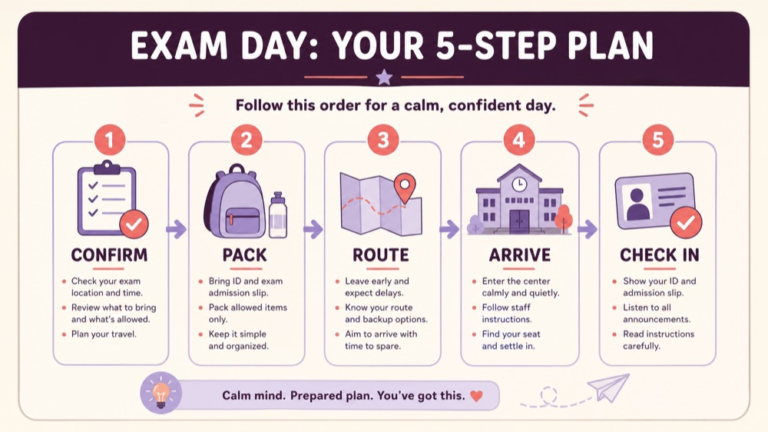
Begin with the record that determines where and when you need to appear. ETS’s registration flow asks test takers to sign in or create an account, select a test, choose a date and location, review the cart, and complete payment. The current registration page also explains that appointment management, including rescheduling or cancellation questions, belongs in the related ETS process. Do not treat a search-result snippet, a social post, or an old screenshot as your appointment confirmation.
Open the account and compare the details line by line. Confirm that the registration is for Speech-Language Pathology 5331 rather than a similarly named assessment. Confirm the delivery method, because the current ETS 5331 page describes test-center and at-home options while availability can depend on the account and appointment. Confirm the local time shown for the appointment, the address if you selected a center, and the name spelling attached to the account. Save the confirmation in a place you can access without depending on a fragile browser tab.
If your program, state agency, or credentialing body has given you a deadline, write that deadline beside—not instead of—the ETS appointment information. A deadline is a reason to verify the plan early; it is not proof that every appointment or score-reporting step will fit automatically. ASHA explains that the Praxis exam is part of a broader certification pathway, while states can set their own credential rules. Keep the administrative goal visible, but use the responsible authority for the rule that applies to your situation.
Your first verification pass can be short:
- Test name and code: Speech-Language Pathology 5331.
- Appointment date and start time as displayed in the ETS account.
- Delivery method: test center or at-home, if that option is actually confirmed.
- Test-center name and full address, if applicable.
- Approved accommodation details, if applicable.
- Name and identification details that must match the admission instructions.
- Any score-recipient or institution information you chose during registration.
- Contact or support instructions to use if the appointment record is unclear.
Pack for the Appointment Without Overpacking
Testing locations may restrict what can enter the room, so the best bag is usually a small, deliberate bag rather than a mobile study desk. Follow the current admission and security instructions for your appointment. The ETS Study Companion explains that test takers should expect to provide proper identification at a test center and that the computer interface gives an opportunity to learn how to answer, skip, and return to questions before testing time begins. That means the checklist should protect the admission process and your focus, not encourage you to carry unapproved materials.
Prepare the night before. Put the items you are allowed to bring together, then check them against the live appointment instructions. If you need an item related to an accommodation, keep the approval record or required documentation accessible according to the provider’s instructions. If you are unsure about a permitted item, ask the responsible provider before test day instead of improvising at check-in.
A sensible preparation set may include:
- The identification documents required for your appointment.
- Your appointment confirmation or account reference, available offline if possible.
- Directions, parking information, or transit notes for the selected location.
- Contact details for the testing provider or support channel.
- Glasses or other personally necessary items that comply with the rules.
- A simple snack and water for before or after the appointment if the location permits them outside the room.
- Layers that help you stay comfortable while respecting the center’s instructions.
- Any approved accommodation documentation or required assistive item.
- A backup payment or travel plan only where it is relevant to the appointment instructions.
Leave unnecessary study materials at home unless the location explicitly permits them. A last-minute flashcard stack can increase anxiety without improving recall. The better final review is a short list of reminders, followed by sleep and a predictable morning.
Plan Arrival and the Check-In Sequence
Work backward from the appointment start. Estimate the route at the time of day you will travel, then add time for parking, building entry, finding the room, and check-in. If the center is unfamiliar, look at the surrounding streets and entrance instructions in advance. If you are using public transportation, identify one reasonable alternative in case of a delay. The purpose of the buffer is not to arrive hours early and become tense; it is to avoid turning one small delay into a rushed admission decision.
Keep the first part of the morning boring. Eat a familiar meal if you normally eat before a long assessment. Set one alarm and one backup alarm. Put the phone on the setting required by the testing provider before entering the room. At check-in, listen to the instructions before asking a question. If a staff member directs you to a rule that differs from your assumption, pause and follow the current local procedure.
If the address, room, date, or identification requirement does not match what you expected, do not try to solve the discrepancy by guessing. Show the appointment record, ask the staff member what can be verified, and contact ETS support when the issue requires a registration decision. Document names, times, and instructions if a formal follow-up is needed. A calm record is more useful than an argument or a hurried attempt to start the exam.
Use a Simple Pacing Plan
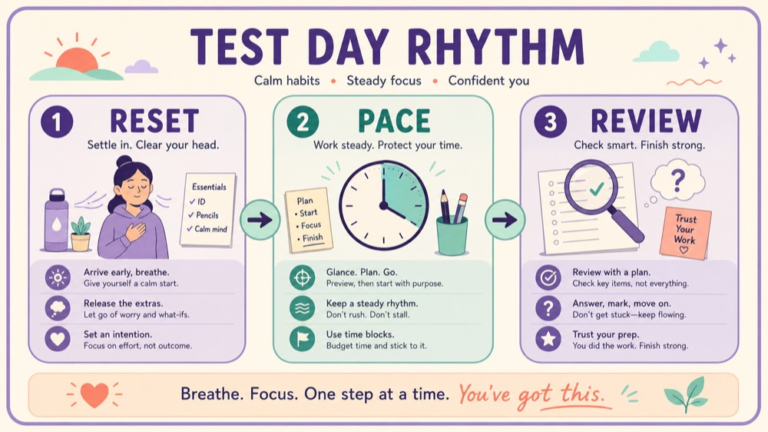
The current ETS 5331 listing states that the test has 132 selected-response questions and a 150-minute test length. Those are useful planning anchors, but they are not a promise that every item should take exactly the same amount of time. The rough division is a little more than one minute per question. Some items will be faster, while a difficult item may need a marked return rather than a long struggle.
Choose a pacing rule before the first item appears. For example, read the question carefully, identify what it asks, eliminate unsupported options, choose the best answer, and mark the item if a second look could help. The exact interface and review controls should be learned from the test instructions and tutorial available for your appointment. Your practice routine should make the process familiar enough that you can use it without narrating every step to yourself.
Use checkpoints instead of watching the clock after every question. A checkpoint asks whether you are broadly on track and whether you have left enough room for marked items. It is a steering signal, not a reason to panic. If you are ahead, use the extra margin to review uncertain items. If you are behind, shorten the time spent on any one question and make a reasoned selection before moving forward.
- Start by reading the stem for the task, population, setting, and decision being tested.
- Separate a question about best next step from a question about a definition or fact.
- Eliminate options that conflict with the stated evidence, scope, or safety context.
- Do not let one unfamiliar term consume the time needed for several answerable items.
- Mark an item only when returning to it could realistically improve the decision.
- Use the interface’s approved navigation and review features as explained before testing begins.
- Keep your pace flexible when a passage or case requires careful reading.
- Reserve a final review window for marked items and obvious misreads.
For practice, rehearse the same sequence with mixed-domain questions. After each set, record whether a miss came from knowledge, reading, reasoning, pacing, or a careless selection. That diagnosis of your process is more actionable than simply counting correct answers. It tells you what to change before the appointment.
Finish the Night Before and Morning Of
The final evening should close open loops. Check the appointment one more time, lay out permitted items, confirm the route, and set a realistic departure time. Then stop. A final hour of unfocused studying can make the morning harder, especially when it displaces sleep. If you want a review, choose a small set of high-yield reminders: common distinctions, professional-practice boundaries, and the reasoning steps you tend to skip.
On the morning itself, follow the sequence you prepared. Arrive with enough margin to think. Read the admission directions. Once the test begins, let the first few items establish your rhythm rather than treating them as a verdict about the entire exam. If anxiety rises, lower your shoulders, take one controlled breath, reread the question, and return to the task being asked.
After the appointment, write down only what you need for a next administrative step. Do not try to reconstruct every item from memory or seek claimed or remembered test content. ETS and ASHA materials are the appropriate references for policies, scores, and credentialing context. Your useful post-test information is whether a score report, score recipient, retake, or certification action needs follow-up.
A Printable Final Check
Use this short version when you are about to leave:
- Appointment: correct test, date, time, delivery method, and location.
- Account: confirmation accessible and name details reviewed.
- Admission: identification and accommodation instructions confirmed.
- Route: departure time, entrance, parking or transit, and backup identified.
- Bag: only permitted essentials, with comfort items handled according to policy.
- Body: familiar food, water plan, clothing layers, and reasonable sleep.
- Mind: one pacing routine and one reset strategy.
- Aftercare: know where to check official score or credentialing next steps.
For current administrative details, review the ETS Speech-Language Pathology 5331 listing, the ETS registration process, and the applicable ASHA Praxis exam guidance. If you want a structured preparation path, explore the SLP Study Center preparation resources, then adapt the plan to your current coursework, practice needs, and official instructions.