
pediatric feeding differential diagnosis is a way to organize why a child may have difficulty eating or drinking without forcing every sign into one explanation. It separates the feeding event, the swallowing question, the child’s development, the medical and nutritional context, the feeding skills involved, the psychosocial environment, and the next information needed. Pediatric feeding disorder and dysphagia are distinct diagnoses that may co-occur, so a useful differential map keeps both the overlap and the distinction visible.
This guide is for SLP students and other learners reviewing clinical concepts. It does not make an individualized diagnosis, select a diet, or replace current professional guidance. A child’s communication, culture, family routines, sensory experiences, health, development, and participation all affect how feeding evidence should be interpreted.
What pediatric feeding differential diagnosis means
Start by separating feeding from the narrower question of swallowing. Feeding includes the broader experience of eating and drinking, including accepting food, preparing it, chewing or sucking, moving it through the mouth, swallowing, managing the mealtime routine, and obtaining enough nourishment and hydration. Dysphagia focuses on swallowing impairment, while pediatric feeding disorder can involve impaired oral intake that is not age appropriate and may be related to medical, nutritional, feeding-skill, or psychosocial factors. The categories help organize assessment; they do not turn one behavior into a diagnosis.
| Question area | What to examine | What the learner should avoid |
|---|---|---|
| Medical | Medical history, gastrointestinal or aerodigestive concerns, structural findings, respiratory status, neurologic conditions, cardiac history, medications, and current stability. | Assuming the mealtime pattern identifies one medical cause without medical and team evidence. |
| Nutritional | Nutrition and hydration, growth or intake concerns, metabolic factors, appetite, medication effects, energy needs, and access to sufficient intake across settings. | Treating intake quantity as the only measure of feeding function or choosing a plan without the appropriate team. |
| Feeding skill | Oral sensory response, lip closure, tongue movement, chewing, bolus control, oral containment, transfer, coordination, efficiency, and endurance. | Calling every refusal a skill deficit or inferring pharyngeal physiology from behavior alone. |
| Psychosocial and environment | Child and caregiver stress, mealtime interaction, routines, distractions, expectations, hunger and satiety cues, family practice, and participation with peers. | Describing food avoidance as bad behavior or ignoring the context that may maintain or reduce difficulty. |
The same observable event can lead to different questions. A child who turns away from a spoon may be communicating satiety, discomfort, sensory sensitivity, lack of readiness, pain, fatigue, a learned expectation, or a preference. A prolonged meal may reflect feeding skill, endurance, positioning, distraction, scheduling, medical status, or the time available at school. The observation matters, but the interpretation must stay proportional to the evidence.
For Praxis 5331 study, remember the relationship among age and developmental status, medical or surgical history, assessment method, differential diagnosis, interpretation of data, and referral. A strong answer names the decision being made and selects the information that can answer it. It does not substitute a memorized label for a child-specific assessment question.
Map pediatric feeding differential diagnosis
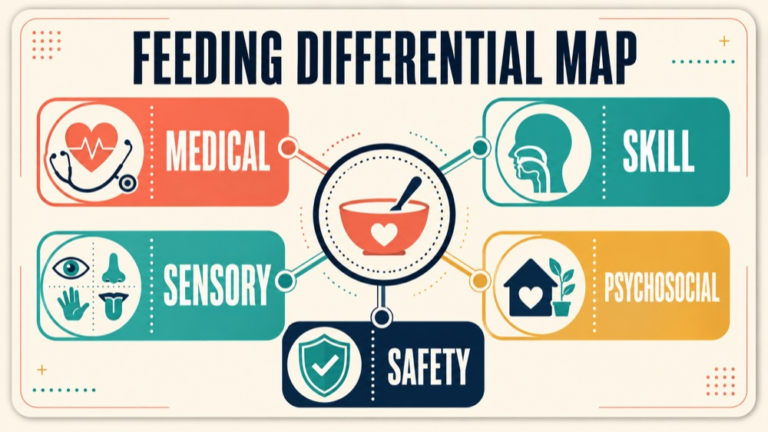
A practical map begins with the child’s usual feeding event. Note what is offered, how it is offered, how the child responds, who is present, what support is available, and what happens to safety, efficiency, nutrition, hydration, comfort, and participation. Then sort the evidence into the four contributing areas while allowing more than one area to be relevant.
- Medical: review relevant gastrointestinal, airway, pulmonary, structural, neurologic, cardiac, developmental, and medication factors.
- Nutritional: ask whether the child can obtain enough nourishment and hydration across home, school, child care, and medical settings.
- Feeding skill: observe sensory response, sucking, chewing, lip closure, tongue movement, bolus management, endurance, and coordination.
- Psychosocial: consider stress, anxiety, caregiver–child interaction, expectations, routines, distractions, and the meaning of food avoidance.
- Development: compare feeding skills with the child’s developmental level and current medical or motor status rather than age alone.
- Culture and family practice: include familiar foods, utensils, positioning, dietary beliefs, religious practice, language, and family priorities.
- Environment: examine seating, posture, schedule, sensory load, television or devices, peer context, and the time available for eating.
- Function and participation: connect the pattern with comfort, meals, school access, peer inclusion, caregiver burden, autonomy, and quality of life.
This map is useful because it prevents a narrow answer. Medical and feeding-skill factors may coexist. A child may have a swallowing impairment and also experience stress around meals. A child may eat a limited range of foods because of sensory or skill factors, a medical history, family routines, or a combination of influences. The learner’s job is to describe what is known, identify what is uncertain, and choose the next proportionate assessment or referral.
From feeding evidence to a coordinated plan

Clinical evaluation should resemble the child’s meaningful feeding context as closely as safety and competence allow. Case history and record review can clarify birth, medical, developmental, growth, respiratory, gastrointestinal, allergy, medication, and feeding history. Interviews with caregivers and professionals can show how the pattern changes across people, foods, settings, and routines. Observation of eating or being fed can reveal what happens with familiar foods, typical utensils, usual positioning, and the supports the family actually uses.
| Assessment layer | Question it can help answer |
|---|---|
| History and interview | When did the concern begin, what changes it, and how does it affect health, routines, family interaction, and participation? |
| Clinical observation | What happens with alertness, posture, oral structures, chewing, bolus control, secretion management, respiration, and fatigue? |
| Trial of support | Does a carefully selected change in positioning, utensil, texture, pacing, schedule, or cueing change the observed task, and what remains unknown? |
| Team and referral | Which medical, nutrition, occupational therapy, physical therapy, behavioral health, educational, or family perspective is needed? |
| Instrumental evaluation | Is more information needed about anatomy or swallowing physiology after clinical evaluation to determine the plan of care? |
Instrumental assessment is not a default response to every feeding concern. ASHA describes VFSS and FEES as common pediatric instrumental evaluations when more information is needed about the presence and pathophysiology of dysphagia. The decision depends on the clinical question, suspected or documented impairment, medical stability, participation skills, and whether the findings are needed to determine care. A repeat study should be tied to a change in status or a new information need rather than an arbitrary schedule.
Referral boundaries matter in differential reasoning. An SLP may assess feeding and swallowing and collaborate with the team, but suspected eating disorders such as avoidant/restrictive food intake disorder require referral to appropriate behavioral health professionals. Medical, nutrition, respiratory, dental, occupational therapy, physical therapy, nursing, educational, and psychosocial questions may require other professionals. The best plan makes the handoff visible instead of treating one discipline as the explanation for every domain.
Apply pediatric feeding differential diagnosis reasoning
When a Praxis-style scenario presents a child with feeding or swallowing difficulty, work through the decision in sequence. The question is often not simply what the child has; it is which evidence, assessment, referral, or team action best fits the concern and the child’s current condition.
- Define the event: state whether the concern involves accepting food, oral preparation, swallowing, intake, nutrition, hydration, mealtime interaction, or participation.
- Locate the pattern: identify the medical, nutritional, feeding-skill, psychosocial, developmental, cultural, or environmental clues without forcing a single category.
- Check safety and stability: consider alertness, respiratory status, posture, fatigue, secretion management, and the child’s ability to participate.
- Separate observation from inference: record what was seen or reported and identify whether anatomy, physiology, etiology, or eating-disorder expertise remains outside the current evidence.
- Choose the next information: select history, interview, observation, tool, dynamic trial, instrumental evaluation, medical examination, nutrition review, or referral that answers the specific question.
- Keep function visible: connect the plan with nourishment, hydration, comfort, family routines, school access, peer inclusion, caregiver support, autonomy, and quality of life.
Imagine a child who takes a long time to finish lunch and occasionally holds food in the mouth. The strongest first step is not to label the child from those two observations. Ask about the child’s developmental level, typical foods, oral skills, posture, alertness, fatigue, medical history, respiratory changes, school schedule, caregiver report, and whether the pattern is consistent across settings. Then decide whether clinical assessment, team referral, or more specific swallowing information is needed. The reasoning remains open until the evidence supports a narrower conclusion.
For exam review, compare answer choices by asking which one matches the level of certainty. A broad educational suggestion may be premature if the stem signals a medical or safety question. An instrumental procedure may be excessive if the stem asks about an initial feeding history. A behavior-focused explanation may miss the child’s communication, sensory, developmental, or medical context. The best choice is usually the one that answers the stated question while respecting safety, scope, and referral boundaries.
Common study mistakes
- Using pediatric feeding disorder and dysphagia as interchangeable terms when the distinction matters to the question.
- Assuming one food refusal, cough, prolonged meal, or oral-motor behavior identifies one cause.
- Ignoring the four contributing areas by focusing only on oral motor skill or only on caregiver behavior.
- Interpreting a child’s feeding pattern without considering development, medical stability, nutrition, hydration, fatigue, posture, or respiratory status.
- Replacing the family’s familiar foods, utensils, positioning, language, and routines with an artificial task and then treating the result as the whole profile.
- Assuming a clinical observation can answer every question about pharyngeal anatomy or swallowing physiology.
- Using an adult dysphagia framework without adapting the assessment to pediatric development, caregiver participation, and family context.
- Failing to refer or collaborate when the concern includes medical, nutrition, behavioral health, occupational therapy, physical therapy, educational, or other professional needs.
These mistakes come from treating a multidomain feeding problem as a quick label. Correct the habit by returning to the event, the evidence, the context, the uncertainty, and the next responsible action. A good study explanation can be concise while still naming what is observed, what is suspected, what needs confirmation, and who should be involved.
Build a quick review map
Use this compact map when reviewing a missed feeding and swallowing question:
- Step 1: Define the concern and the child’s feeding, swallowing, nutrition, hydration, comfort, or participation outcome.
- Step 2: Sort clues into medical, nutritional, feeding-skill, psychosocial, developmental, cultural, environmental, and functional domains.
- Step 3: Compare the report with a safe observation of typical foods, utensils, positioning, caregivers, schedule, and setting.
- Step 4: Decide what clinical evaluation can answer and what requires instrumental, medical, nutritional, behavioral health, or other professional input.
- Step 5: Check whether a support changes the task while keeping the child’s communication, autonomy, family priorities, and safety in view.
- Step 6: Write the next step and its boundary: what will be assessed, who will collaborate, what remains uncertain, and how the plan will be monitored.
Then write one transfer sentence: When I see this pattern, I will first check ___ because ___. The sentence should identify a decision rule rather than repeat a definition. Revisit it with a different age, food texture, caregiver, medical history, cultural routine, or setting so that the reasoning remains flexible.
Sources and next steps
pediatric feeding differential diagnosis is best learned as a structured but flexible way to connect feeding events with development, health, skills, family context, participation, assessment, and referral. Use the current authority pages below to deepen the concept, then practice explaining why a particular next step fits the evidence and why a tempting shortcut does not.
Start with ASHA Pediatric Feeding and Swallowing, ASHA Assessment Tools, Techniques, and Data Sources, ASHA Scope of Practice in Speech-Language Pathology, and the ETS Praxis 5331 Study Companion. These sources support the learning frame; they do not replace current topic-specific guidance, individualized assessment, medical care, or applicable local requirements.
Continue your preparation: Explore the SLP Study Center learning resources.