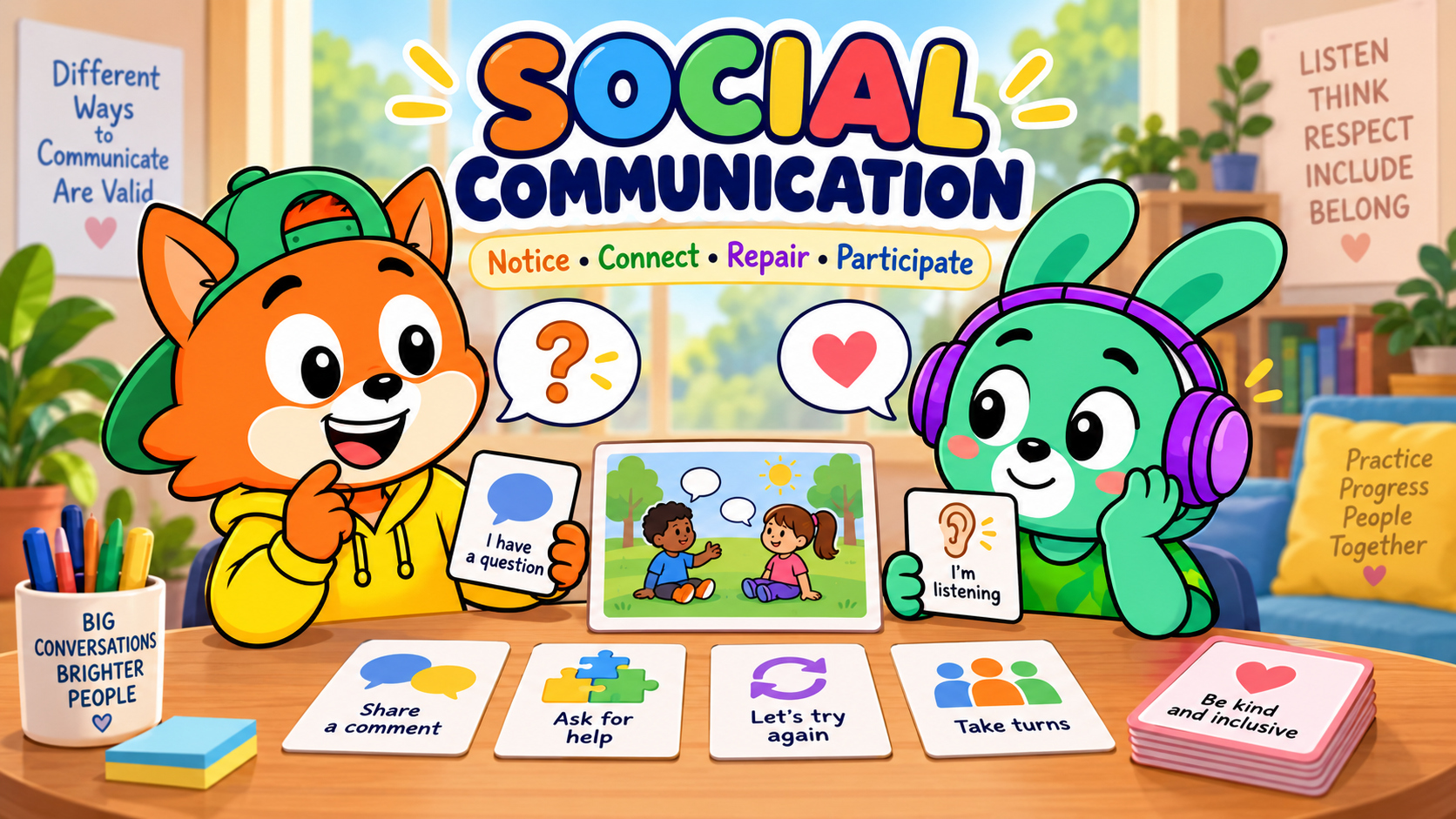
Social communication is the way a person uses communication with other people across relationships, routines, and settings. It includes more than eye contact or a list of conversation rules. A person may be working on starting an interaction, responding to a partner, asking for information, sharing an idea, reading a cue, repairing a misunderstanding, changing a message for a new listener, or participating in a group. The most useful practice connects the skill to a reason to communicate.
This guide is for SLPs, educators, caregivers, and support partners planning social communication activities. It is educational information rather than an individualized diagnosis or treatment plan. Target selection should consider language, culture, dialect, neurodiversity, hearing, cognition, motor access, communication mode, consent, and the person’s own participation priorities. ASHA’s Social Communication Disorder practice information provides broader context for assessment and intervention planning.
Table of Contents
- What social communication includes
- Start with a meaningful participation task
- Teach the interaction before the rule
- Build a notice, plan, say, and repair routine
- Practice across partners and settings
- Support speech, AAC, gesture, and writing
- Fade prompts while preserving autonomy
- Differentiate the communication demand
- Collect data that explains participation
- Common questions about social communication
What Social Communication Includes
Social communication can involve language, nonverbal signals, partner expectations, and the timing of an interaction. It may include choosing a topic, taking a turn, staying with a shared idea, asking a follow-up question, interpreting a message, using an appropriate repair, or ending an interaction. The same person may use a skill successfully with a familiar partner and need support in a noisy group or unfamiliar routine.
Avoid reducing a broad communication profile to one visible behavior. A learner who looks away may still be listening, and a learner who uses a device or script may be participating meaningfully. Start by describing the communication task and the partner’s response rather than assuming that one outward behavior represents social understanding.
Useful social communication targets can include:
- initiating a greeting, request, comment, or shared topic;
- responding to a partner’s message with a related word, phrase, question, or symbol;
- asking for information, clarification, repetition, or extra time;
- recognizing when a message was not understood and repairing it;
- sharing a perspective, preference, feeling, or reason in an accessible mode;
- changing the amount of explanation for a familiar or unfamiliar partner;
- entering, maintaining, or closing a conversation; and
- using a support to participate in a group, routine, or community interaction.
Start With a Meaningful Participation Task
Choose the situation before choosing the worksheet or prompt card. Ask what the person wants or needs to communicate, who the partner is, and what successful participation would make possible. The target could be joining a game, asking a teacher for clarification, sharing an interest with a peer, making a choice, repairing a misunderstanding, or telling a support person what is needed.
Write the target with a clear action and context. “Improve social skills” does not tell a partner what to teach or measure. “During a small-group activity, the learner will make one related comment or ask one related question using speech, AAC, writing, gesture, or a visual support” creates a defined opportunity while preserving response flexibility.
Ask whether the routine is important to the person. A social communication goal is more meaningful when the learner has a reason to interact and can influence the topic, partner, mode, or support. Include the person’s preferences and boundaries rather than treating conformity to one conversational style as the only outcome.
Teach the Interaction Before the Rule
Social communication instruction is easier to use when it begins with what is happening in the interaction. Instead of presenting a rule such as “take turns,” show a shared activity and identify the current speaker, the listener’s opportunity, and the options for joining. Instead of “make eye contact,” teach how to show attention in a way that is comfortable and accessible, such as orienting toward the partner, using a device, responding to the message, or asking for a repeat.
Use examples and non-examples that make the communication purpose visible. A partner can model a related response, an off-topic response, a repair, and a respectful way to close the exchange. Then invite the learner to explain or choose what could happen next. The goal is flexible participation, not memorizing a single response for every situation.
Build a Notice, Plan, Say, and Repair Routine
A short routine can help a learner organize an interaction without turning the interaction into a rigid script. The routine can change as the learner gains experience, and the learner can choose which support remains available.
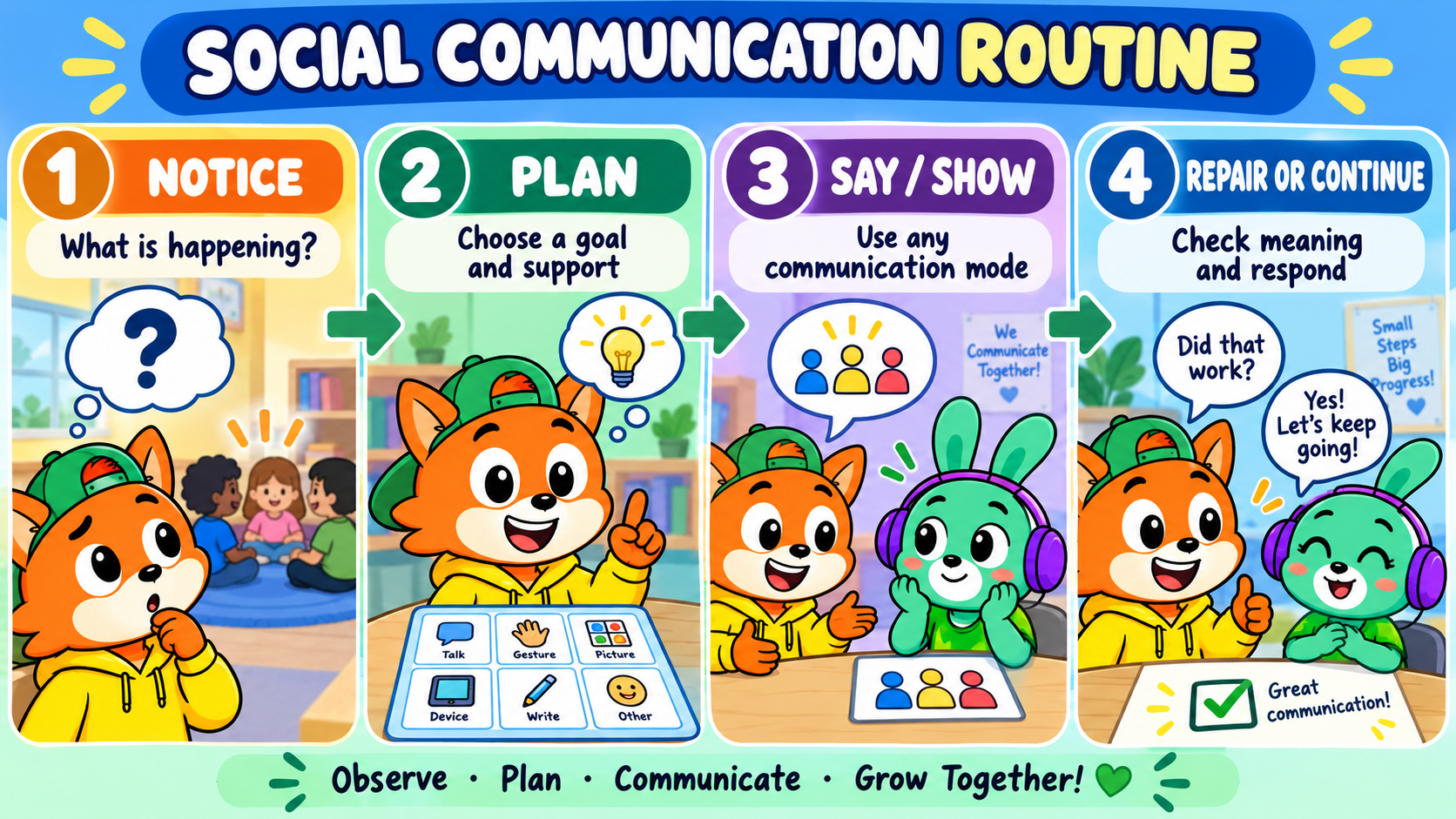
Use four steps:
- Notice: What is happening, who is involved, and what information matters?
- Plan: What is the communication goal, and which response mode or support feels useful?
- Say or show: Communicate the message through speech, AAC, writing, sign, gesture, pointing, or a multimodal combination.
- Repair or continue: Check the partner’s response, clarify if needed, add information, change the topic, or close the interaction.
For example, during a group project, the learner might notice that a material is missing, plan to request it, use a spoken or written message, and repair by pointing or rephrasing if the partner does not understand. The clinician can practice each step separately and then combine them in a real routine.
Practice Across Partners and Settings
Social communication changes when the partner, setting, noise, topic, time pressure, or communication mode changes. Practice should therefore include planned variation. Begin with a predictable partner or topic when the routine is new, then vary one feature at a time so the learner can notice what changes.
Possible practice contexts include:
- a shared book, game, or preferred interest;
- a classroom discussion or group task;
- a phone or video call with a familiar partner;
- asking for help during a daily routine;
- joining a conversation in a community setting;
- clarifying a direction or written message; and
- explaining a preference, boundary, or support need.
Keep the communication purpose stable while changing the context. A learner may practice asking a related question about a shared picture, then about a class topic, and later with a family member. The question form remains familiar while the partner, topic, and response demand become more flexible.
Support Speech, AAC, Gesture, and Writing
Social communication practice should not assume that spoken language is the only way to participate. A learner may use AAC, writing, typing, sign, gesture, pointing, drawing, eye gaze, a visual script, or combined modes. The team can measure the function of the message and the partner’s understanding instead of counting speech as the only meaningful response.
Prepare supports that match the routine. A topic board can help with initiation, a repair card can support clarification, a visual sequence can organize a group task, and a written key can reduce retrieval demand. A device page or communication book may need vocabulary for requesting, commenting, asking, rejecting, repairing, and closing an interaction.
Partners have an important role. They can wait, respond to the message, confirm meaning, offer a repair opportunity, and avoid speaking for the learner when the learner is still communicating. Train the partner to recognize multimodal responses and to make room for processing time.
Fade Prompts While Preserving Autonomy
Fading support means adjusting the cue while preserving access to the interaction. Do not remove a support simply because the learner uses it. A visual topic list, written key, device page, or prepared repair phrase may be the tool that makes participation possible in a demanding setting.
Change one feature at a time. Reduce a verbal reminder while keeping the written support, vary the partner while keeping the topic choice, or move from a role-play to a real routine while keeping the response mode. Record what changed and whether the learner could communicate the intended message.
Respect the learner’s choice to pause, decline, change a topic, or use a different mode. Social communication goals should include self-advocacy and boundaries when those are relevant to the person’s safety and participation. The purpose of support is to create more communication options, not to require performance on demand.
Differentiate the Communication Demand
Adjust the activity without changing its purpose. For an early target, use a familiar partner, clear visual choices, a short exchange, and a predictable topic. For a developing target, add a related question, a repair turn, or a new partner. For a more advanced target, use a group, an unfamiliar topic, a change in plan, or a message that requires the learner to explain a perspective.
Consider these adjustments:
- reduce or expand the number of conversation choices;
- use a visual topic map or written key word;
- model two possible responses and discuss their effects;
- add a planned misunderstanding for repair practice;
- ask the learner to choose how to start or end the interaction;
- change one partner or setting feature at a time; and
- include the learner’s preferred mode throughout the activity.
Collect Data That Explains Participation
Define an opportunity before collecting data. One opportunity might be one initiation, one response, one repair, one request for clarification, or one turn in a group task. Decide whether the goal is independence, partner understanding, flexibility, use of a support, or a combination.
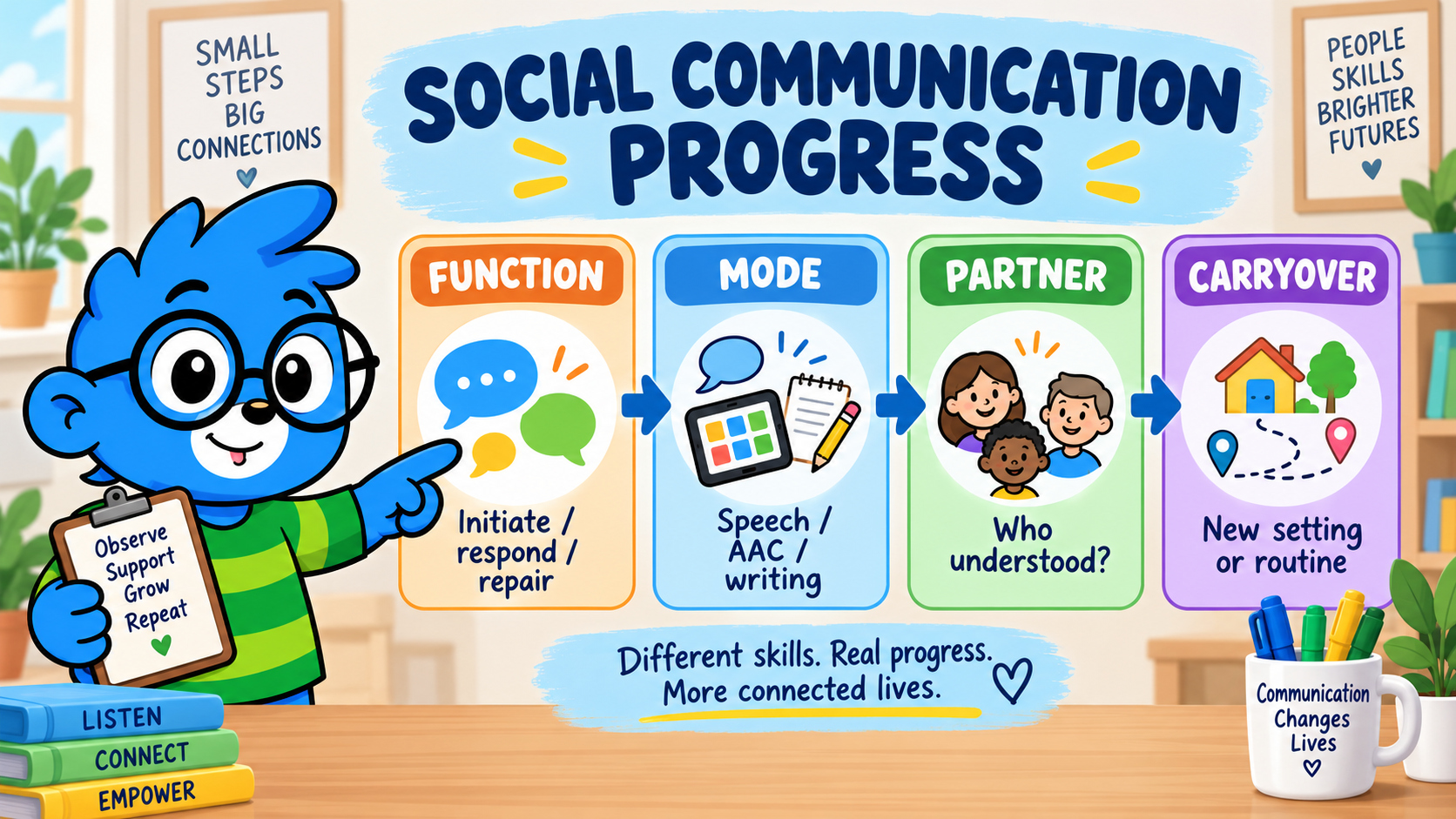
Track the communication function, context, partner, response mode, cue level, and outcome. A useful record can note whether the learner initiated, responded, repaired, changed the message, and remained involved in the routine. Include partner understanding and the learner’s preference when those details affect the interpretation.
Review patterns across settings. If the learner communicates successfully in a one-to-one session but not in a group, the next step may be partner training, visual support, reduced language load, or a smaller group rather than more isolated trials. If the learner uses a repair card independently with one partner, plan a new partner or routine while keeping that support available.
Common Questions About Social Communication
What is social communication? It is the use of communication with other people across relationships, settings, and routines. It can include initiation, response, topic sharing, perspective, clarification, repair, turn-taking, self-advocacy, and closing an interaction.
What activities support social communication? Use meaningful routines such as shared books, games, group projects, conversations about interests, problem-solving, community tasks, phone calls, and self-advocacy practice. Make the communication purpose clear and allow an accessible response mode.
Does social communication require eye contact? No single outward behavior represents every person’s attention or understanding. Focus on the communication task, partner response, access needs, and a form of participation that is comfortable and meaningful for the learner.
Can AAC be used for social communication? Yes. AAC, writing, sign, gesture, pointing, typing, speech, and multimodal communication can support initiation, response, repair, self-advocacy, and relationship-building.
How do I measure progress? Define an opportunity and track the function, context, partner, response mode, support level, partner understanding, repair, and carryover. A percentage without context may not show what changed.
How should prompts be faded? Change one support feature at a time while keeping the learner’s access to the interaction. Keep useful supports available when they help the learner communicate and self-advocate.